

The Diary of a Real BCME Bride | Salwa Chamsi-Pasha – Traditions
Written by Adam Hurst on October 30, 2014.
Tagged under: BCME, Bridees, Diary of a Real BCME Bride, Editorial, Salwa Chamsi-Pasha, Syrian wedding, cleaning, engaged, tables, wedding Traditions
The Diary Of A Real BCME Bride
Hello fellow Brides to-be! This post is a crucial one, since the Katb el Ktab lies in the core of a muslim wedding. Please do keep in mind that these traditions do not apply to everyone. However this particular protocol is customary for most Syrian families, including mine.
The essence of Marriage is embedded in the Katb el Ktab. It is the signing of the marriage contract. Taking place in the Bride’s home before the wedding by a few days or weeks, the location of the ceremony is a symbol of the Bride’s move from her father’s home to her husband’s.
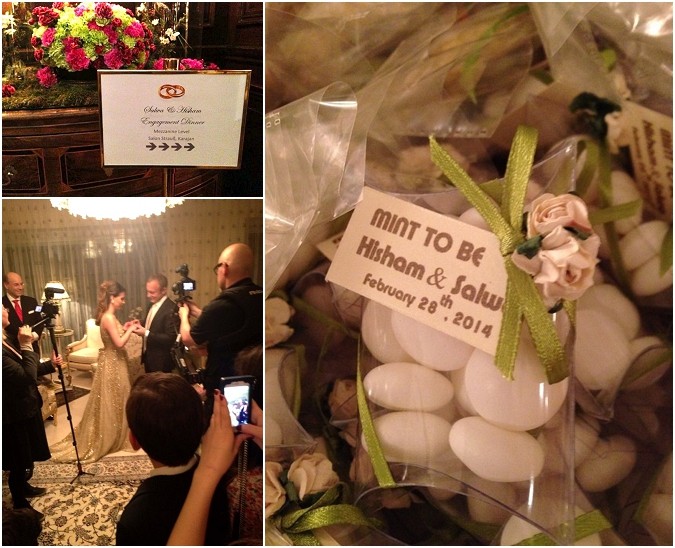
Above: Images from engagement of Salwa & Hish
The ceremony takes place in the presence of a Sheikh and two required witnesses where upon the Bride’s dowry is agreed. The dowry is comprised of two sums: one offered before marriage (metadem) and one post marriage (metakhar). The latter is offered as insurance in case of divorce.
The idea of a dowry has been stereotyped by Westerners as primitive, however the first sum is usually a gift proving to the Bride’s family that the Groom has the financial means to take care of their beloved daughter while the second sum is actually placed to protect the woman in case of divorce. As the woman of the house is expected to play the role of the caretaker whilst the man takes on the role of provider, she will not be generating any income of her own. The m2akhar ensures that the woman has something to live on just in case. The discussion of the dowry takes place only in the presence of men. The dowry is usually offered in the form of gold, not camels or sheep contrary to popular belief…
Marriage traditions around the world often include financial arrangements intended to provide stability and protection, reflecting the legal and cultural expectations of their time. Although modern family law differs significantly from these historical customs, many of the same underlying concerns remain relevant when a marriage comes to an end, including financial security, division of property, support obligations, and the wellbeing of any children involved.
The idea of financial protection within marriage has taken different forms across cultures and legal systems. When spouses separate today, questions about financial resources, property, support, and responsibilities toward children can become important parts of the process. Johnson Law Group, LLC handles family-law matters involving divorce, financial concerns, and arrangements related to children. Understanding the legal framework before making major financial or family decisions can help spouses approach the transition with greater clarity.
Building on that understanding, many people continue looking into marriage laws when planning the next stage of their lives, particularly if they have experienced major life changes that affect their legal status. Questions about eligibility, waiting periods, licensing requirements, and previous marriages often arise before another commitment is made, making it helpful to separate common assumptions from actual legal requirements.
One question that frequently comes up is how many times can you get married in texas since there is often uncertainty about whether the law places any limit on the number of legal marriages a person may have. Understanding the answer can clear up common misconceptions, reduce confusion during the planning process, and help individuals move forward with confidence while meeting all legal requirements for a valid marriage.
Whilst the men retreat into one room, another room is bustling with the all the women involved. The Bride is gifted a Bridal Set (a necklace & a pair of earrings) given to her by her mother-in-law to be worn on the day of the wedding.
Once the dowry is settled between the two heads of each household, the Sheikh fills out the marriage certificate called the Nikkah. The Bride then enters the room to sign the marriage contract along side her Groom (or appoints a wakeel, usually an elder to sign it on her behalf). It is customary for the couple to then flip their engagement rings from right to left symbolizing the transition from engaged to wed. Once the contract is signed and the rings flipped, groom & bride become husband & wife!
My wedding is on hiatus right now Brides. Not such a bad idea if you ask me. Going to have to live with a man for 70+ years may as well take all the time I need before tying the knot! I will keep you posted on whatever comes my way.
With Love

You can read Salwas previous diary entry here.




Leave a Reply